
Marc Standing

Updated: Apr 24
My Own Peculiar (2024)
Close Looking: Queer African Art and Intimacy
Visual description:
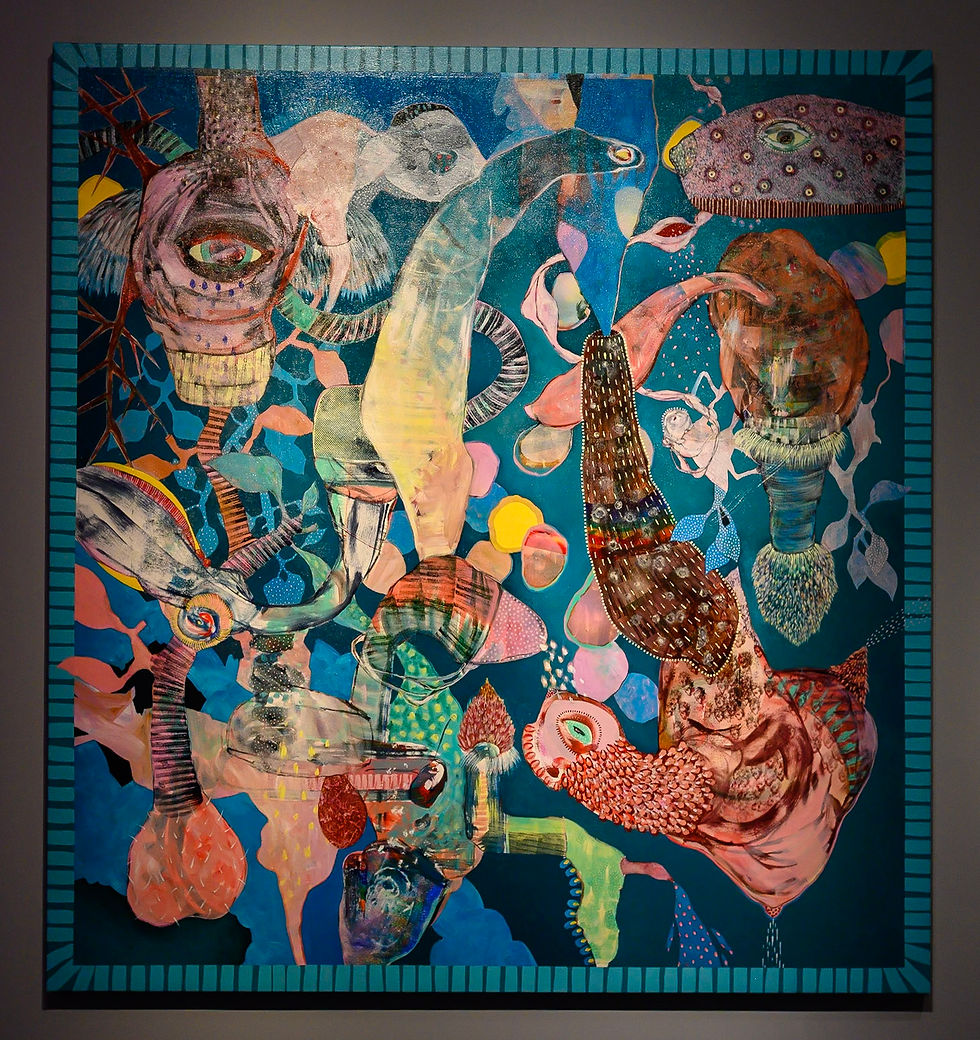
My Own Peculiar presents a surreal landscape of organic forms suspended within a deep blue space. The teal background creates an atmosphere that feels almost underwater, allowing the central shapes to appear vivid and luminous. These forms resemble masks, creatures, and fragments of living organisms.
One mask in the top left appears as a singular eye with human teeth, suggesting a face that distorts itself for protection. Across the center, clustered shapes evoke internal organs, vein-like tubes, and translucent sacs. These forms reflect the artist’s interest in natural structures such as shells and bones. In the top right, a pink and purple creature with a single eye gazes outward. At the bottom right, a larger textured form with a similar eye turns toward the center of the composition.
The entire scene is contained within a border of vertical light blue lines, which introduces a sense of structure to the otherwise fluid imagery. The painting feels less like a depiction of a specific place and more like a map of thoughts or internal states.
Context:
Marc Standing is a Zimbabwean artist who was born in Harare in 1976 and now works in London. His practice explores identity, cultural heritage, and the subconscious. Drawing on his experiences within the African diaspora, he combines elements of folklore, natural history, and personal memory.
Standing describes his process as a form of psychic automatism, where the subconscious guides the creation of the work. He has spoken about how recurring mask imagery connects to his experience as a gay man, particularly during adolescence, when he felt the need to hide parts of himself behind constructed personas.
This personal narrative connects to broader traditions of African masks, which often carry symbolic meanings and draw on natural or zoomorphic forms. In this work, abstract shapes and mask-like figures become a way of exploring identity as something layered, shifting, and sometimes concealed.
Interpretation:
The mask forms can be read as representations of constructed identities that allow the artist to move through environments that may feel unsafe or restrictive. At the same time, the organic shapes suggest an internal world of thoughts, emotions, and desires that remain active beneath these surfaces.
The overlapping and continuous movement between forms may reflect both the artist’s life as a traveler and the evolving nature of identity. Some of the figures appear unfamiliar or even alien, which could suggest experiences of not belonging or feeling out of place.
Reflect and Explore
Consider the motif of singular eyes. Why do many of them look in different directions? Is there a clear focal point?
What is the effect of combining human features, such as teeth, with non-human or abstract forms?
How do the organic shapes relate to traditional African mask forms? What feels similar or different?
What role does the striped border play? Does it suggest protection, containment, or something else?
How does the mood of the painting shift when you think about the artist’s use of subconscious or automatic drawing?
Oscar Wilde wrote, “Give him a mask, and he will tell you the truth.” What kinds of truth might these masks reveal?
Learn More
Artist & Primary Sources
Further Resources
Contextual Reading


Comments