
Arvin Ombika

Updated: Apr 29
Juxtaposition of Aurora Borealis and Aurora Australis (2023)
Close Looking: Queer African Art and Spirit
Visual description:
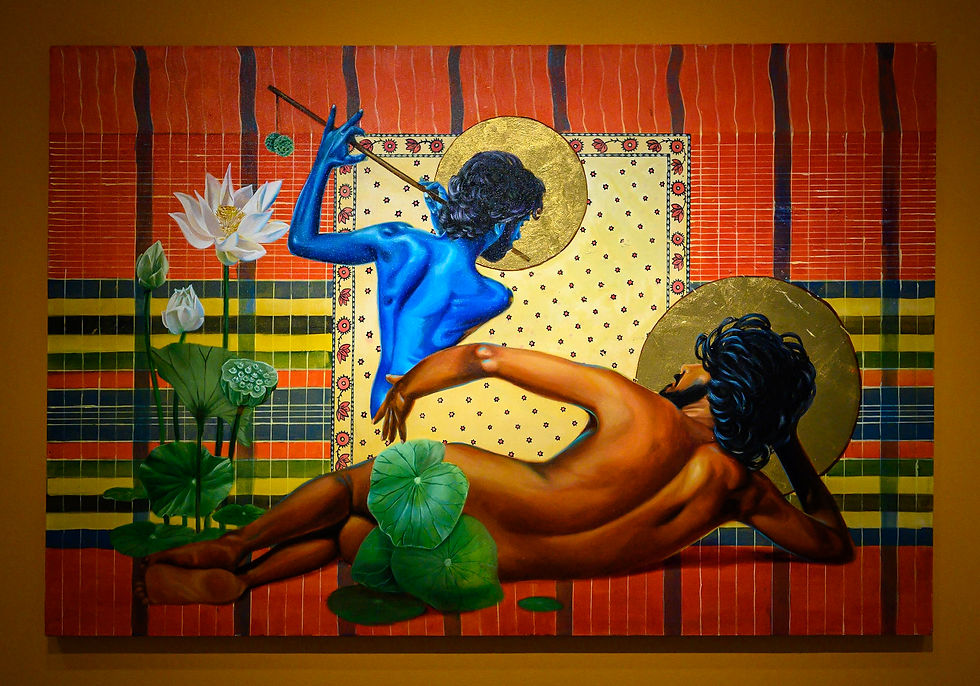
Two figures occupy a layered, dynamic composition set against a vivid striped background of red, yellow, blue, and gray. The background includes a textile panel with a faint floral pattern symbolic of cultural heritage. The backdrop resembles woven fabric, giving the painting a strong textile presence.
The first figure, a brown-skinned man, lies across the canvas. He is painted in warm earth tones and crowned with a gold halo above his head. The second figure, painted in bright cobalt blue, stands above him with one arm raised. This figure is also marked by a radiant gold halo. The halos overlap slightly, creating a visual connection between the two bodies. The overlapping halos create a zone of luminosity that unites the two figures and conveys sacredness.
At the left of the composition are white lotus flowers and broad green lily pads. These forms introduce a quieter, more meditative element into the work. The use of egg tempera, acrylic, and gold leaf gives the painting a luminous surface and an almost icon-like quality.
The blue figure's raised arm is the abhaya mudra — a Hindu gesture meaning 'providing fearlessness and protection to the devotee. The blue figure appears partially formed, rising from or above the brown figure's body, suggesting it may be an apparition.
Context:
Arvin Ombika is from Pamplemousses, Mauritius, and currently lives and works in Ébène, Plaines Wilhems District. He often layers paint and gold leaf to create richly textured images that draw on the island’s multicultural and multireligious history.
This painting belongs to his larger body of work Threads of Faith, in which Ombika brings together elements of his own identity with traditions of belief found across Mauritius. The island has long been shaped by the movement of people, religions, and cultural practices across the Indian Ocean.
According to the museum label, the painting’s title refers to Mauritius as a place where traditions from different parts of the world meet. The background includes layered references to mouswar and gamcha, textiles associated with one of the island’s largest communities, descended in part from indentured laborers in a predominantly Hindu society. The museum acquired this piece in 2025. The Aurora Borealis and Aurora Australis are produced by the same process but occur at opposite ends of the earth and can never be seen at the same time. Belief in spirits, including the djinn, is shared across Creole, Hindu, and Muslim communities in Mauritius and is used to explain illness and unusual behavior.
Interpretation:
The work suggests a meeting of opposites that do not cancel each other out. The title evokes northern and southern lights, hinting at a relationship between distant poles, human and divine, self and tradition, earthly and sacred.
The blue figure may be read as Krishna, one of the most widely revered Hindu deities and an important spiritual presence in Mauritius. The reclining nude figure is understood by the museum to represent the artist himself. By placing his own body beside a divine figure, Ombika brings personal identity into sacred space rather than leaving it outside.
The overlapping halos reinforce this relationship. They suggest not only proximity, but shared spiritual resonance. The artist is not simply observing tradition from a distance. He is placing himself within it.
The lotus flowers add another layer of meaning. Across multiple traditions, including Hinduism and Buddhism, the lotus can symbolize purity, awakening, and emergence. Here, they may suggest spiritual calm arising from a complex and layered history.
The textile background is equally important. It grounds the work in Mauritian cultural memory and links spirituality to everyday materials, labor, and inheritance. In that sense, the painting becomes not only devotional, but historical. It reflects a society in which identities are formed through contact, layering, and coexistence.
In Hinduism, darshan refers to the mutual sacred gaze between worshipper and deity — Krishna blesses the worshipper in the act of being seen. The blue figure could represent Krishna, a spirit, an ancestor, or an inner vision — these readings are not mutually exclusive. The mouswar is associated with Muslim communities; the gamcha with Hindu Indo-Mauritian communities. Together in the background, they enact cultural hybridity rather than just representing it.
Reflect and Explore
What do you notice first when you look at this painting? How does your eye move through it?
What do the mouswar and gamcha textiles in the background suggest about Mauritian history and identity?
Why might Ombika place his own body alongside a divine figure? What effect does that create?
What do the gold halos add to the work? Where else have you seen this visual convention?
How do the lotus flowers relate to the figures and to the spiritual mood of the painting?
What does the title suggest about opposites, coexistence, and balance?
What does this painting say about growing up in a multicultural, multireligious society?
What does the title Juxtaposition of Aurora Borealis and Aurora Australis suggest? Why did Ombika reference the two poles of the earth?
What is the effect of Ombika using his own body as subject and placing himself inside the sacred narrative?
Learn More
Artist & Primary Sources
Further Resources
Contextual Reading
Museum of African Art wall label — Juxtaposition of Aurora Borealis and Aurora Australis (2023)


What gets me about this painting is how Ombika doesn't separate himself from the sacred, he places himself right inside it. Lying beside a figure that reads as Krishna, with their halos overlapping, feels like a claim that his identity belongs within that spiritual tradition rather than at its edges. The textile background grounds all of that in something real and inherited, not abstract. And the lotus flowers quietly hold the whole thing together. It's devotional and personal at the same time, which is a hard balance to pull off.